
Team
We are based at the department of Hepatology and Gastroenterology at the Charité Universitätsmedizin Berlin (CVK, CCM).

Marina Kolesnichenko (group leader): My fascination with molecular biology goes back to my doctoral studies at Oxford University, where I worked on alternative RNA processing. After Oxford I joined the lab of Peter K. Vogt at the Scripps Research Institute to do a PhD on TORC1 in cellular senescence. At that time it emerged that NF-kB is responsible for the senescence associated secretory phenotype. I had to understand how that works on a transcriptional level, so I joined the lab of Claus Scheidereit at the Max Delbrück Center for Molecular Medicine for a postdoc. Over the next few exciting years we explored different dynamics and transcriptomes of NF-kB. We identified mechanisms responsible for divergent transcriptomes and novel, unexpected functions of the pathway. Towards the end of my postdoc I knew I needed to see where these different transcriptomes of NF-kB make an impact. I started looking at its activity in the context of inflammatory diseases. Now in my own group at the Charité Universitätsmedizin Berlin we integrate methods from these different fields to determine how time, location, and stimulus shape NF-kB transcriptomes and contribute to health and disease.

Hey there! My name is Antony Schneegans, I’m a young biochemist and just joined Dr. Kolesnichenko’s lab at the Department of Hepatology and Gastroenterology at Charité to work on my PhD. I have conducted my bachelor and master studies in the small university town of Jena, where I specialized in immunology and infectiology. I am most interested in studying cellular signaling cascades and deciphering the implications for the host when those run aberrant. Properly identifying the problem source will hopefully help finding appropriate treatments for consequential cancerous diseases. When not in the lab or office, you will probably find me doing sports, or making excuses for not doing any sports and just hang out with friends in one of Berlins many parks, restaurants, or bars! Having discovered south-east Asia just recently as travel destination, I also hope to explore other parts of the world either as part of a vacation trip or through my scientific work.

Luisa Barleben: an MD/PhD scholar with the Else Kröner-Promotionskolleg “Re-Thinking Health” from Berlin and a recipient of the DGVS stipend. She is a certified physician from Charité – Universitätsmedizin and has gained research experience in a variety of labs, exploring topics ranging from rheumatology to neuroimmunology. She is enthusiastic about investigating signalling cascades and mechanisms responsible for developing inflammatory diseases such as IBD. In addition to her research pursuits, Luisa is also layout editor for the journal Phenotype and has played a key role in coordinating the European Students Conference, one of the leading international symposia in biomedicine for young scientists. Throughout her medical studies, she worked with the Women’s and Equal opportunities officers at the Charité, where she was responsible for public relations and statistical analysis of data on diversity and gender equality. Outside of the lab, she enjoys hiking trips, singing in choirs, and dabbling in graphic design.

Tim Winkelmann: Hello! My name is Tim Winkelmann and I have completed my medical studies in Budapest and Hamburg. During my practical year at the gastroenterology department of Charité, I gained valuable experience in treating patients with inflammatory bowel disease. Currently, I am pursuing my MD at Kolesnichenko Lab where I am interested in learning more about signaling pathways and mechanisms that lead to the development of Crohn’s disease and ulcerative colitis. When I am not in the lab, I enjoy watching movies and taking photographs with analog cameras. I also try to explore the city since I recently moved to Berlin.

Franziska Flohr: I have recently joined Dr. Kolesnichenko’s laboratory in the Department of Hepatology and Gastroenterology at Charité as a biology laboratory technician. I completed my dual vocational training at the Max Delbrück Center for Molecular Medicine. During that time, I worked in a research group focusing on the Molecular Genetics of Chronic Inflammation and Allergic Disease, where I gained valuable experience working on patient samples. Following that, I had the opportunity to be part of a research group, focusing on cancer and immunology. There, I practiced techniques such as the cloning of various antibody constructs, pseudovirus production, and other immunological methodologies. Outside of the laboratory, I am passionate about reading, cycling, attending concerts, and baking.
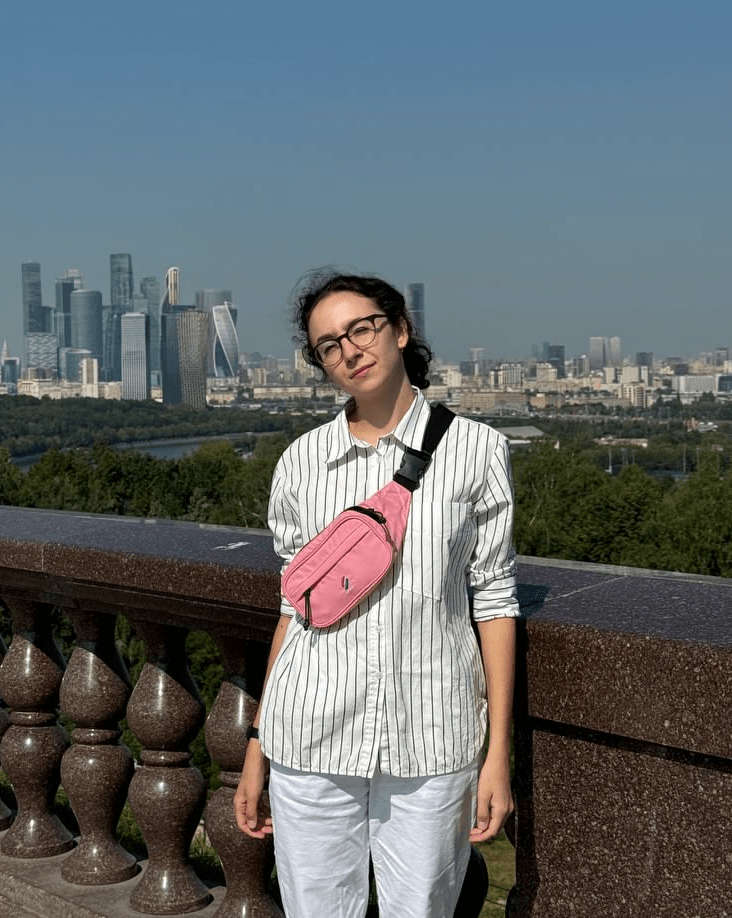
Giomar Vasileva: Hi, my name is Giomar and I joined Dr. Kolesnichenko’s lab as a PhD Scholar (BSIO, Deutsche Studientstiftung). I completed my bachelor’s degree in genetics and my master’s degree in bioinformatics in St. Petersburg, Russia. I have always been interested in the interaction of molecular pathways (especially Nf-kB) and their role in determining cell or even tissue fate in oncology and other diseases. Along with this, I admire the bioinformatics and systems biology approach for it allows me to turn tons of disparate experimental data into meaningful conclusions. I wish I had unlimited time in the day, because in addition to science, I am interested in art history, literature, birdwatching, and sports such as sailing and horse riding.

Florentine Gröne: Hey, I’m a medical student in my seventh semester at Charité – Universitätsmedizin Berlin. In October 2025, I joined the Kolesnichenko laboratory as a MD student. During my medical studies, I was able to gain initial research experience in the laboratory and in statistical data analysis. Building on this, I am now interested in gaining a deeper insight into experimental and translational research to better understand the molecular mechanisms of health and disease. As part of my doctoral thesis, I am investigating the role of epithelial NF-κB in intestinal metabolism. The aim is to open up new perspectives for the prevention of metabolically induced DNA-damage and the associated reduction in the risk of neoplasms in the gastrointestinal tract. Outside the lab and university, I enjoy spending time with friends, doing sports, and traveling.
.
Alumni:
Lisa Drees 2024-2025 (currently PhD student at HAW)
 Kolesnichenko Lab